Why Do Two Neighboring Homes Have Different Radon Levels?
Why Your Neighbor's Radon Test Can't Tell You What's Happening in Your Home
If your neighbor recently tested their home for radon and received a low result, you might assume your home is probably safe too. After all, the homes are on the same street, built on the same land, and may even have been constructed around the same time.
But when it comes to radon, two homes sitting right next to each other can have very different results.
One home might test below 2.0 pCi/L while the house next door measures above the EPA action level of 4.0 pCi/L. In some cases, the difference can be even greater.
That's because radon levels aren't determined by your neighborhood. They're determined by a combination of the soil beneath your home, the way your home was built, and how air moves through it.
Radon Starts in the Ground
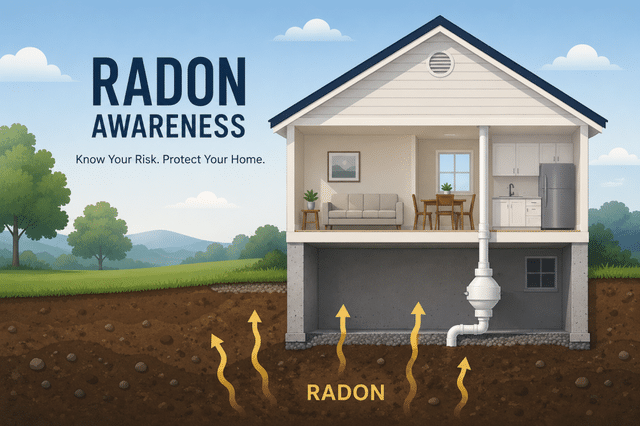
Radon is a naturally occurring radioactive gas produced by the breakdown of uranium in soil and rock. Because it comes from the ground, the conditions directly beneath a home play an important role in how much radon may enter.
Those underground conditions aren't necessarily uniform.
Soil composition, rock formations, cracks, moisture and pathways through the ground can change over surprisingly short distances. Two neighboring homes can therefore have different amounts of radon available beneath their foundations—or different pathways allowing that radon to reach the house.
Every Foundation Is Different
Even homes that look nearly identical from the street may be very different below ground.
One home may have a basement while another has a crawlspace or slab-on-grade foundation. There may be differences in foundation cracks, plumbing penetrations, sump pits, floor drains or other openings that allow soil gases to enter.
Even two homes built from the same plans can develop different conditions over time.
Radon doesn't need a large opening to enter a home. Small cracks and gaps can provide pathways from the soil into the living space.
Your Home Can Actually Pull Radon Inside
Radon doesn't simply rise out of the ground and enter every house equally.
Homes can develop negative air pressure relative to the soil beneath them. When that happens, the house can act somewhat like a vacuum, drawing soil gases through openings in the foundation.
Heating and cooling systems, exhaust fans, fireplaces, weather conditions and normal differences in air pressure can all influence how air moves through a home.
That means two neighboring houses can interact with the soil beneath them very differently.
Crawlspaces Can Add Another Variable
Crawlspace homes are common throughout the Triangle, and they introduce another set of factors.
The condition of the crawlspace, ventilation, exposed soil, vapor barriers and connections between the crawlspace and the living area can all affect radon movement. Changes to the crawlspace can matter too. Encapsulating a crawlspace, adding or replacing a vapor barrier, or changing how the space is ventilated can alter air movement and potentially affect radon levels in the home.
A neighboring home with a similar floor plan may have completely different crawlspace conditions—and therefore a different radon result.
Well Water Can Be Another Source of Radon
For homes with private wells, radon can also be present in groundwater. When water containing radon is used for showering, washing dishes and other household activities, some of that radon can be released into the indoor air.
Just like radon in soil, groundwater conditions can vary from property to property. A neighbor's well-water radon result doesn't necessarily tell you what's in your well.
For homes with elevated indoor radon and a private well, testing the water may sometimes help determine whether well water is contributing to the home's overall radon level.
Even the Same Home Can Have Different Radon Levels Over Time
Radon levels aren't constant.
Weather, rainfall, soil moisture, temperature and changes in how a home is heated or cooled can cause radon concentrations to fluctuate throughout the year.
That's one reason a single result from the house next door can't reliably predict what's happening inside your own home.
Your neighbor's test tells you something important: their radon level during their test.
It doesn't tell you yours.
The Only Way to Know Is to Test Your Home
Radon is invisible, odorless and tasteless. There is no way to look at a home—or even look at the neighboring homes—and determine whether it has elevated radon.
Testing is the only way to know.
This is especially important when buying a home, but testing can also make sense for homeowners who have lived in the same house for years and have never checked their radon level.
And if elevated radon is found, the good news is that radon can usually be reduced effectively with a properly designed mitigation system.
Radon Testing and Mitigation in the Triangle
At Triangle Radon Defense, we provide professional radon testing and mitigation services throughout the Raleigh, Durham and Chapel Hill areas.
We've worked in homes of nearly every foundation type—from slabs and basements to crawlspaces and combination foundations—and one thing remains consistent:
Every home needs to be evaluated on its own.
Your neighbor's radon result can be interesting information, but it shouldn't determine whether you test your own home.
Know your home's number. Don't borrow your neighbor's.
If you have questions about radon testing, an elevated result, or an existing mitigation system, contact Triangle Radon Defense. We're happy to help you understand your options.