Buying a Home in North Carolina? Don't Skip the Radon Test
A Home Can Look Perfect and Still Have Elevated Radon
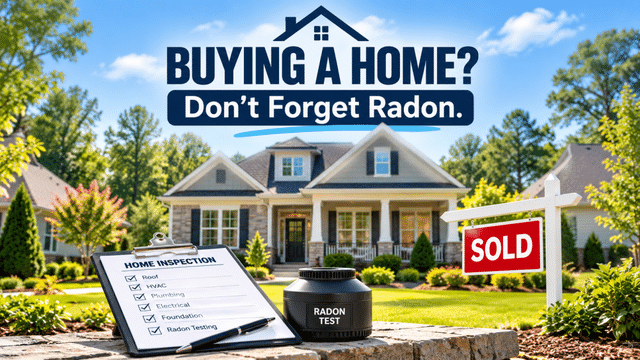
Buying a home comes with a long list of things to evaluate. The roof, HVAC system, plumbing, electrical system, foundation and dozens of other components may all get attention during the inspection process.
But one potential concern can't be seen during a walkthrough or discovered simply by looking at the house: radon gas.
Radon is invisible, odorless and tasteless. A home can be well maintained, relatively new and show no obvious signs of a problem while still having elevated radon levels.
That's why radon testing can be an important part of the home-buying process.
A Home Inspection Doesn't Tell You the Radon Level
A professional home inspection can provide valuable information about the condition of a property, but radon requires a separate test.
You can't determine a home's radon level by looking at the foundation, checking the crawlspace or knowing the age of the house.
You also can't reliably predict it based on what other homes in the neighborhood have tested.
As we discussed in our previous article, even two neighboring homes can have very different radon levels. Differences in soil, foundation construction, air pressure and pathways between the ground and the home can all affect the result.
The only way to know the radon level in the home you're buying is to test that home.
When Should Radon Testing Happen During a Home Purchase?
For most buyers, radon testing is performed during the due-diligence or inspection period so the results are available before important decisions about the property need to be made.
Testing during a real-estate transaction needs to be performed under appropriate conditions so the result accurately represents the home during the test period.
Doors and windows, heating and cooling systems, test-device placement and even where the device is located within the house can matter. That's one reason professional testing can be particularly valuable during a real-estate transaction.
The goal isn't simply to get a number. It's to get a result you can confidently use when making decisions about the home.
Newer Homes Can Have Radon Too
One common misconception is that radon is primarily a problem in older homes.
It isn't.
Radon originates primarily from the soil and rock beneath a home, so the age of the house doesn't determine whether elevated levels will be present.
New construction techniques may help reduce radon entry in some homes, and some newer homes include radon-resistant features. But those features don't tell you what the actual indoor radon concentration is.
New house or old house, testing is still the way to know.
What Does the Radon Test Result Mean?
Radon is measured in picocuries per liter of air, usually written as pCi/L.
The U.S. Environmental Protection Agency recommends taking action to reduce radon when levels are 4.0 pCi/L or higher. The EPA also notes that homeowners may want to consider mitigation when levels are between 2.0 and 4.0 pCi/L.
It's also important to understand that radon levels can fluctuate. Weather, soil moisture, temperature and how the home is being operated can all influence radon concentrations.
A properly conducted test gives you information about the home's radon level during that testing period and helps determine whether additional testing or mitigation should be considered.
What If the Home Tests High?
An elevated radon result can sound alarming when you're already navigating everything else involved in purchasing a home.
But elevated radon doesn't necessarily mean you've found the wrong house.
Radon can usually be reduced effectively.
A properly designed mitigation system creates negative pressure beneath the home and safely vents radon gas outdoors before it can enter the living space.
The exact system depends on the house. Slab foundations, basements, crawlspaces and homes with multiple foundation types may require different approaches.
If a home already has a mitigation system, that doesn't eliminate the need for testing either. The system should be operating properly, and the radon level should still be verified.
Buying a Home With a Crawlspace?
Crawlspaces are extremely common throughout the Triangle, and they deserve special consideration when evaluating radon.
Some crawlspaces are traditionally vented. Others have vapor barriers or have been fully encapsulated. Those differences can affect how air and soil gases move beneath and into the home.
Encapsulation can significantly change the airflow characteristics of a crawlspace, which is another reason you shouldn't assume that an older radon result still represents current conditions after major changes have been made to the home.
When elevated radon is found in a home with a crawlspace, mitigation may involve creating negative pressure beneath a sealed membrane to prevent radon from entering the crawlspace and living areas above.
Buying a Home With a Private Well?
For homes supplied by private wells, there can be another potential source of radon: groundwater.
Radon dissolved in well water can be released into the indoor air when the water is used for showering, washing dishes and other household activities.
An indoor-air radon test doesn't tell you how much radon is present in the well water. In situations where a private-well home has elevated indoor radon—or where groundwater radon is otherwise a concern - water testing can provide additional information.
And just as neighboring homes can have different indoor radon levels, neighboring wells can have different radon concentrations.
Don't Let Radon Testing Become an Afterthought
There are a lot of moving pieces when purchasing a home, and it's easy for radon testing to become just another checkbox on a long inspection list.
But the information can be valuable.
A radon test can identify an issue you can't see, smell or discover during a traditional home inspection. And when elevated levels are found, there are proven ways to reduce them.
At Triangle Radon Defense, we provide professional radon testing and mitigation throughout the Raleigh, Durham and Chapel Hill areas. We work with homebuyers, homeowners, real estate professionals and home inspectors to help identify elevated radon and determine the appropriate next step.
Before you close on the house, know what's in the air.
If you're buying a home in the Triangle and have questions about radon testing, an elevated test result or an existing mitigation system, contact Triangle Radon Defense. We're happy to help you understand what the results mean and what options are available.