Does Rain Affect Radon Levels in North Carolina?
What Happens Beneath Your Home When the Ground Gets Wet?
When heavy rain moves through North Carolina, homeowners typically think about drainage, standing water, wet crawlspaces, and potential foundation problems.
But there's another concern that often goes unnoticed: how rainfall can influence radon levels inside your home.
Radon is a naturally occurring radioactive gas that forms in soil and rock. It can enter homes through cracks, openings, and other pathways in the foundation.
While radon is present in the environment year-round, the amount that enters a home can change with weather conditions.
And sometimes, rainfall plays a significant role.
How Does Rain Affect Radon Levels?
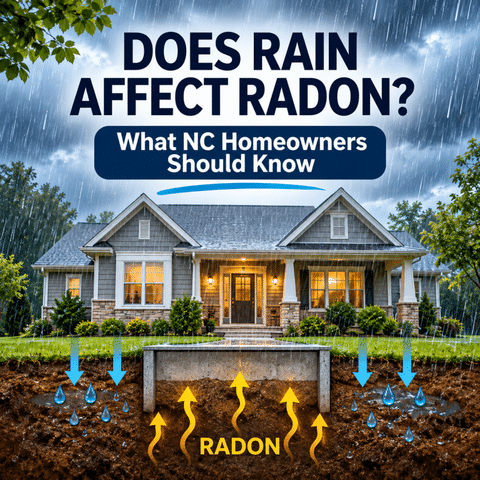
Radon moves through the tiny spaces between soil particles and can enter a home when differences in air pressure draw soil gases toward the foundation.
When rainwater soaks into the ground, it fills some of those spaces and changes how gases move through the soil.
In certain conditions, saturated soil can restrict the normal movement of soil gases toward the surface. This may redirect some of that gas toward areas where it can escape more easily, including openings beneath or around a home's foundation.
As a result, indoor radon levels may increase during or after periods of heavy rainfall.
However, rainfall doesn't always cause radon levels to rise.
Depending on soil conditions, drainage, foundation construction, and other environmental factors, levels may increase, decrease, or remain relatively unchanged.
That's one reason radon levels can behave differently from one home to another.
Why North Carolina Soil Conditions Matter
Soil composition plays an important role in how water and soil gases move beneath a home.
Throughout the Triangle, many properties have clay-rich soils that absorb water and drain differently from sandy or gravelly soils.
Clay-heavy soil can become less permeable when saturated, potentially changing the pathways available for radon gas to travel.
Other factors, including underground rock formations, grading, drainage patterns, and the presence of fill material beneath a foundation, can also influence radon movement.
Even neighboring properties can have different underground conditions.
A home in Raleigh might experience noticeable radon fluctuations following a storm, while another home just down the street shows little change.
The amount of rainfall alone doesn't determine how a home's radon level will respond.
Can Heavy Rain Cause a Temporary Radon Spike?
Yes. Some homeowners who use continuous radon monitors notice their readings increase during or shortly after significant rainfall.
These increases may last for several hours or longer, depending on the conditions.
However, a temporary increase doesn't necessarily mean the home's typical radon concentration has permanently changed.
Radon levels naturally fluctuate throughout the day and across different seasons.
Indoor temperature, outdoor weather, heating and cooling systems, ventilation, and changes in air pressure can all influence the readings.
For homeowners using continuous radon monitors, it's important to look beyond a single hourly measurement.
Longer-term trends provide a better picture of the home's overall radon exposure than an isolated reading.
Want to better understand how radon levels change in your home? Triangle Radon Defense offers continuous radon monitoring through our Radon Monitoring Membership, helping homeowners track fluctuations, identify trends, and stay informed about their indoor air quality. Learn more about our Radon Monitoring Membership.
Does Rain Affect Homes With Crawlspaces Differently?
Crawlspace homes are common throughout Raleigh, Durham, Chapel Hill, and surrounding communities.
These homes can respond differently to rainfall because the crawlspace creates another environment between the soil and the living areas above.
Heavy rain may increase moisture beneath the home, particularly where drainage is inadequate or exposed soil is present.
Crawlspace ventilation, vapor barriers, foundation openings, and connections between the crawlspace and living space can all influence how radon moves through the structure.
What About Encapsulated Crawlspaces?
Encapsulation can change how air and moisture move through a crawlspace.
A properly installed sealed vapor barrier can help limit soil-gas entry into the crawlspace. However, encapsulation alone should not be assumed to provide adequate radon mitigation.
In some situations, changing crawlspace ventilation or sealing the space can alter pressure relationships and affect indoor radon concentrations.
That's why radon testing is recommended after significant crawlspace modifications, particularly when a home has previously experienced elevated radon levels.
Can Rain Affect an Existing Radon Mitigation System?
Homeowners with existing radon mitigation systems sometimes notice changes in their monitor readings following heavy rainfall.
This doesn't automatically mean the system has stopped working.
Rainfall and changes in soil moisture can affect how air moves beneath the foundation. In some situations, these changes may influence the pressure field created by an active radon mitigation system.
Temporary changes in radon readings can occur even when the fan continues operating.
However, consistently elevated readings should not be ignored.
If a home's radon levels remain elevated despite having an active mitigation system, the system may need professional evaluation.
A qualified radon professional can assess system operation, airflow, pressure conditions, and other factors that may be affecting performance.
Should You Avoid Radon Testing During Rainy Weather?
Not necessarily.
Rain is a normal part of North Carolina's climate, and properly conducted radon testing can provide useful information during many weather conditions.
However, unusually severe weather can affect testing conditions and may require special consideration under applicable testing protocols.
For real estate transactions, professional testing should follow established procedures, including appropriate test placement, building conditions, and weather-related requirements.
For homeowners who want to understand how radon concentrations change over time, longer-term testing or continuous monitoring can provide additional insight.
The important thing is to use an appropriate testing method and interpret the results in context.
What If Your Radon Levels Increase After Rain?
If you notice elevated radon readings following rainfall, consider the overall pattern rather than focusing on one measurement.
A brief increase followed by a return to normal readings is different from consistently elevated concentrations.
The EPA recommends taking action to reduce radon when levels are 4.0 pCi/L or higher and considering mitigation when levels are between 2.0 and 4.0 pCi/L.
These recommendations are intended to guide decisions based on appropriate testing, rather than isolated hourly readings.
If your readings remain elevated, additional testing or an evaluation by a qualified radon professional may be appropriate.
And if your home already has a mitigation system, persistent elevated readings may indicate that the system needs attention.
Understanding Radon in Your North Carolina Home
Rainfall is just one of several factors that can influence indoor radon concentrations.
Soil conditions, foundation construction, ventilation, air pressure, and seasonal weather patterns all contribute to how radon moves into a home.
Because these conditions vary from property to property, there is no reliable way to predict your home's radon level based solely on the weather or your neighbor's results.
The only way to understand your home's radon levels is through testing.
At Triangle Radon Defense, we provide professional radon testing, mitigation, and existing-system evaluations throughout Raleigh, Durham, Chapel Hill, Cary, and surrounding Triangle communities.
Whether you're concerned about elevated readings, changes following heavy rainfall, or the performance of an existing mitigation system, our team can help you understand the results and determine the appropriate next steps.
Rain or shine, knowing your home's radon level is an important part of maintaining healthier indoor air.